
Iberians, Romans and the Arab medina
The hill on which Onda stands has been inhabited for more than two millennia. The earliest documented settlements were Iberian, dating from between the 6th and 4th centuries BC, in the territory of the Edetania. The hill offered what it has always offered: height, visual control of the plain and natural protection. Before it was a fortress, it was a home.
Tradition attributes the founding of Onda to Sicorio, "fourteenth king of Spain", who is said to have built the first fortress on the hill in 1535 BC, three centuries before Troy burned.
The account appears in 16th-century chronicles and was enthusiastically revived by local historians of the early modern period. Having Sicorio reign before the Iberians, Romans and Arabs turned Onda into an ancient city with its own noble lineage, owing nothing to any conqueror.
History does not support this claim: there is no archaeological evidence of a settlement so ancient, nor any reliable source placing a king called Sicorio in the peninsula. But the myth is part of local identity, and it says a great deal about how a city builds its own greatness when documented history is not enough.In 214 BC, during the Punic Wars, the Roman generals Quintus Marcius and Publius Cornelius subjugated the settlement. The Roman presence left its mark in the form of inscriptions documenting families established in the area: Pompeia, Baebia, Marcia, Fabia, Aemilia, Celia and Antistia, among others. The name of the town already reflects, most likely, a pre-Roman root that the Arabs would later transcribe as Unda.
The documented history of Onda does not, however, begin in 1237 with the Christian conquest. Its greatest period of earlier splendour was the Islamic era. From the 10th century onwards, the hill became a medina in its own right, under the Yemeni Qays tribes, and was recognised as a regional administrative centre. During this period it was connected to notable thinkers and jurists: Ibn al-Abbar, Abu Becquer and Aben Addabag are names that appear in medieval Arabic sources with roots or family established in the medina.
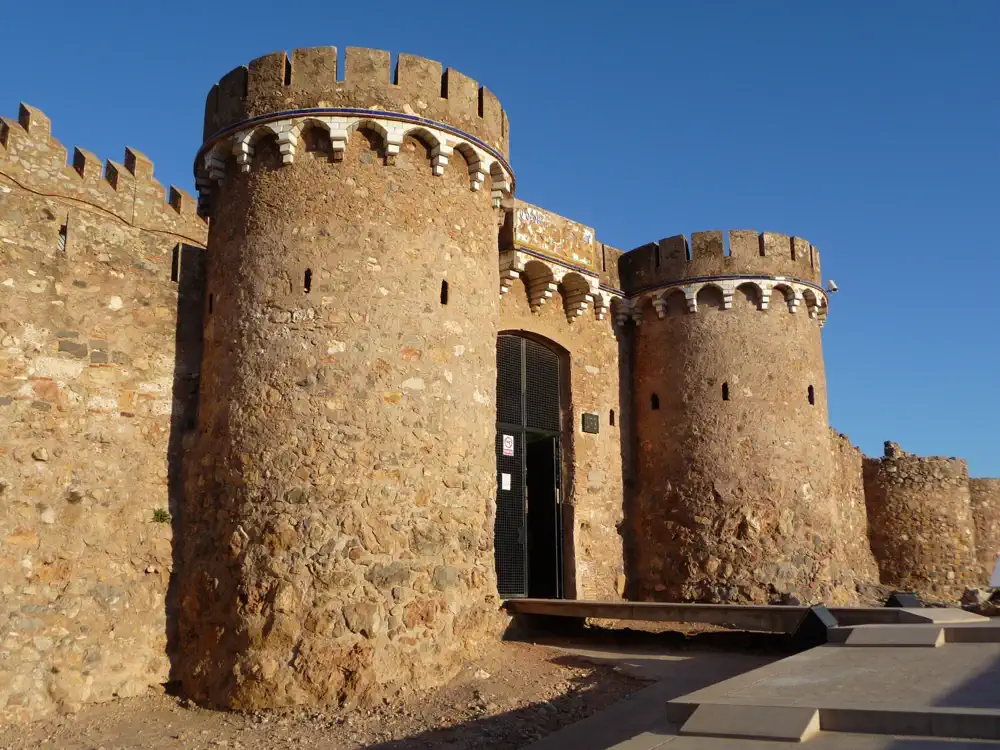
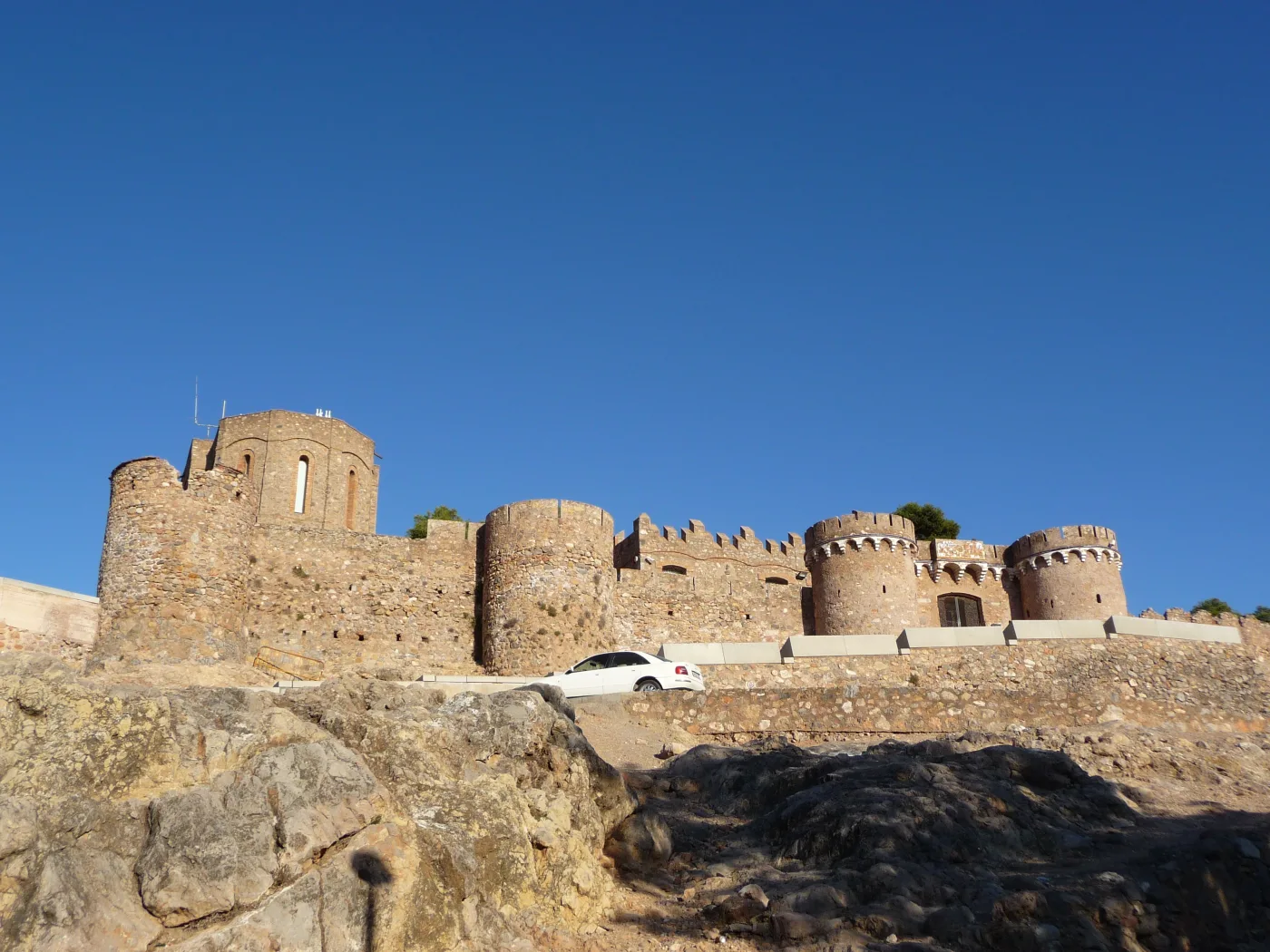
The castle that dominates the hill is not the work of a single period: the walls, towers and enclosures that survive are the result of centuries of construction and reform. What can be seen today is essentially the fortress of the 10th to 12th centuries, which at its height had four concentric walled enclosures, giving rise to the popular name of the castle of the 300 towers. The town extended down the hillside from the castle, with the main mosque at its centre and the neighbourhoods arranged according to Islamic urban logic: streets closed in on themselves, indirect access, transitional spaces between the public and the private. Part of that layout survives today in the historic quarter, readable in the width of the streets and the orientation of the blocks.
The conquest and the division of a world
On 7 April 1248, Jaume I signed the Repartiment of Onda, the document that distributed the properties and lands of the town among the Christian settlers who had taken part in the conquest. The military conquest itself had occurred some years earlier, around 1234-1238, as part of the wider campaign that incorporated the Islamic kingdom of Valencia into the Crown of Aragon.
"And we command that in the towns and castles of the mountains, formerly held by the Saracens, houses and estates be settled with good Christians, for the strength of the kingdom and the service of God."
Modern adaptation inspired by the Llibre del Repartiment del Regne de València (13th c.)The arrival of the settlers did not mean the immediate emptying of the previous population. Onda came to be organised according to the model of the three communities that characterised many medieval Valencian towns: the Christian community inside the walls, the Jewish community in its own quarter within the walled enclosure, and the Muslim community in the Morería (Muslim quarter), outside the walls but integrated into the economic and artisan life of the town.
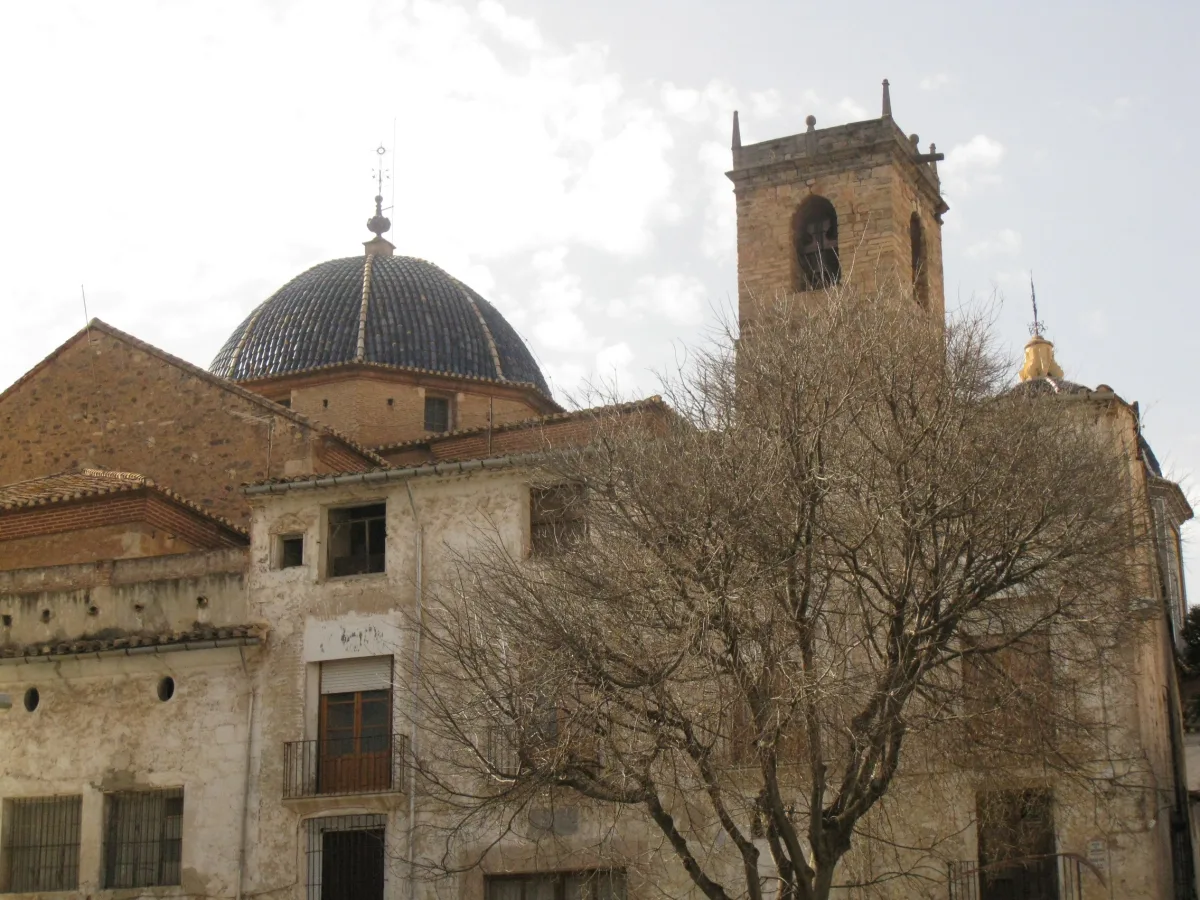
Each community had its own space, its own institutions and its own places of worship. The Jews had their synagogue, now lost, in the area of the square that still bears its name. The Muslims had their mosque in the Morería. The Christians built their own churches: the Iglesia de la Sangre (Church of the Blood, the first, from the 13th century), the Church of the Assumption, the Convent of San Francisco. Coexistence was real but not equal: each community lived under different legal statutes and with different rights.
- 1237 Conquest of Onda Jaume I incorporates Onda into the Crown of Aragon as part of the campaign for the Kingdom of Valencia.
- 1248 Charter of settlement 300 settler families receive land and rights. The three-community model begins.
- 1267 Fair of San Miguel The king authorises the first regulated market of the town, making the Almudín the economic centre.
- 1280 Order of St John Onda passes to the Order of St John of Jerusalem, which governs the town on a military basis.
- 14th c. Order of Montesa The crown transfers Onda to the newly founded Order of Santa María de Montesa.
- 1412 Sant Vicent Ferrer The Dominican preacher delivers a sermon in the Morería quarter, an episode the city would commemorate for centuries.
- 1492 Expulsion of the Jews The Alhambra Decree (the edict by the Catholic Monarchs ordering the expulsion of Jews from Spain) empties the Jewish quarter. The synagogue disappears; the square keeps its name.
- 1609 Expulsion of the Moriscos The town loses its main craftsmen: potters, weavers and irrigation farmers.
- 1610 Census: 720 households First count after the expulsion. It is estimated that between 250 and 400 Morisco families left, some 30-40% of the craftsmen in the Plana.
The expulsion of the Moriscos was, in economic terms, the harshest blow Onda suffered throughout the early modern period. The Moriscos were not merely a distinct religious community: they were potters, weavers, farmers specialised in irrigation agriculture, craftsmen with techniques inherited over centuries. Their departure left gaps that took generations to fill, and some were never filled entirely. The ceramic tradition of Onda, which would flourish two centuries later, did not directly inherit that Morisco heritage, but it did inherit the territory and the kilns they had worked.
Within a handful of city blocks in the historic centre, medieval Onda contained what other cities took kilometres to separate: the Jewish quarter, the Morería and the Christian town, each with its own streets, its own rules and its own memory.
Military orders, monuments and urban life
After the conquest, Onda did not pass to local nobility or the secular clergy, but was ceded successively to two military orders. In 1280 it passed to the Order of St John of Jerusalem; in the early 14th century, the crown transferred control to the newly founded Order of Santa María de Montesa, created precisely to manage Templar assets in the Crown of Aragon. This government by military orders explains the defensive, austere character of the civilian architecture of the medieval town, and the slow development of commercial life compared with other towns in the Plana.
Between the 13th and 15th centuries, Onda was a medium-sized town with a significant role in the administration of the territory. The walled enclosure was articulated around three gates controlling the main access points: Portal de San Pedro to the north, La Safona or San Roc to the east towards the plain, and the Portal de Valencia to the south, on the royal road. The three gates were not merely defensive: they defined the neighbourhoods around them and the economic flows of the town. Only Portal de San Pedro has survived intact to the present day; of La Safona, only the Gothic arch, now embedded in a building facade, survives, and of the Valencia gate only the street layout remains. More on the three gates →
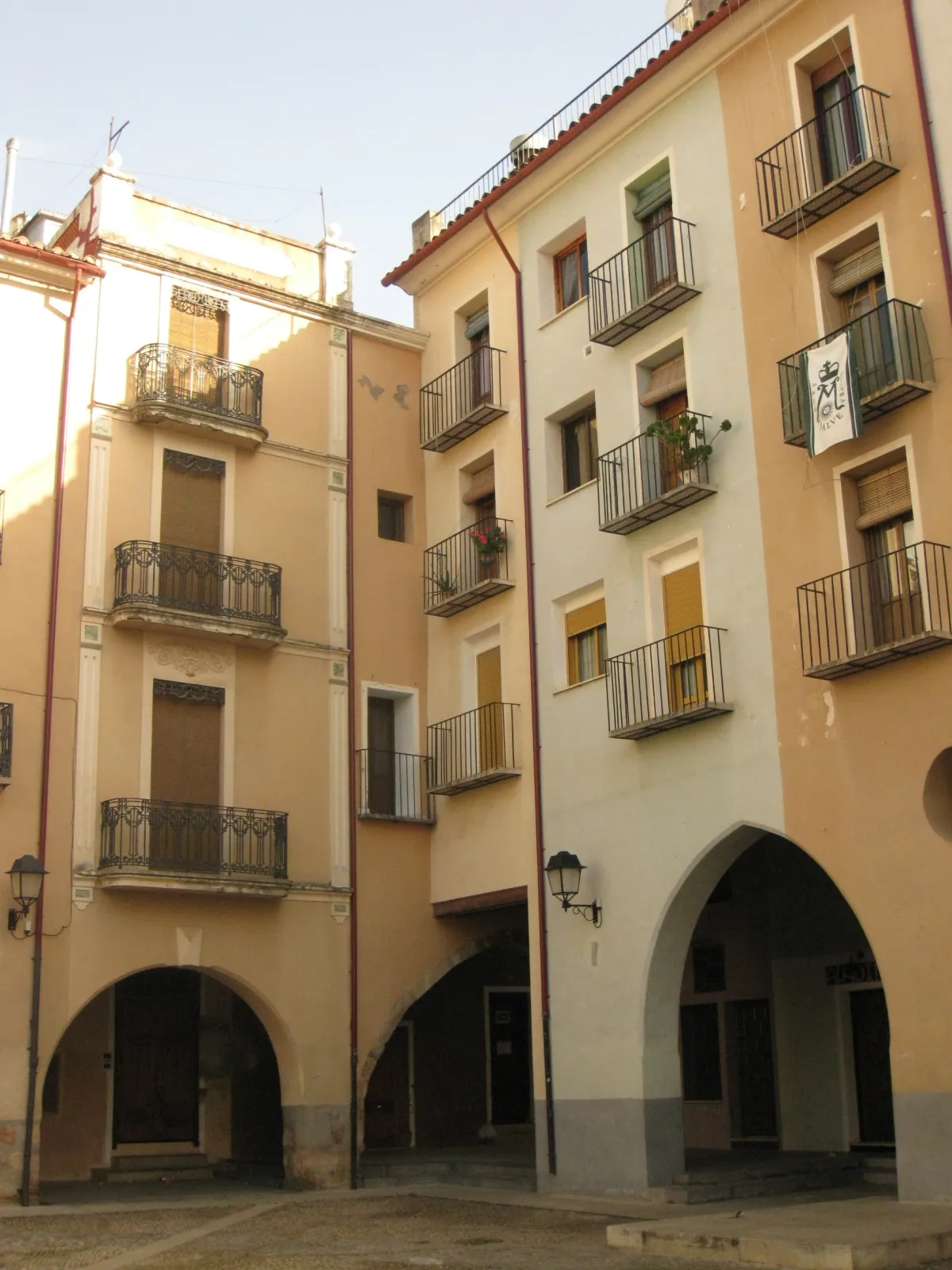
The Almudín, the public granary that regulated the grain trade, was built on the square that still bears its name and is one of the best-preserved medieval civic buildings in the comarca (county). The arcaded square surrounding it, with its porxos (stone porticos), was for centuries the centre of economic and civic life. In 1267, the king had already authorised the Fair of San Miguel, the first regulated market of the town, which would make the square the commercial hub of the region.
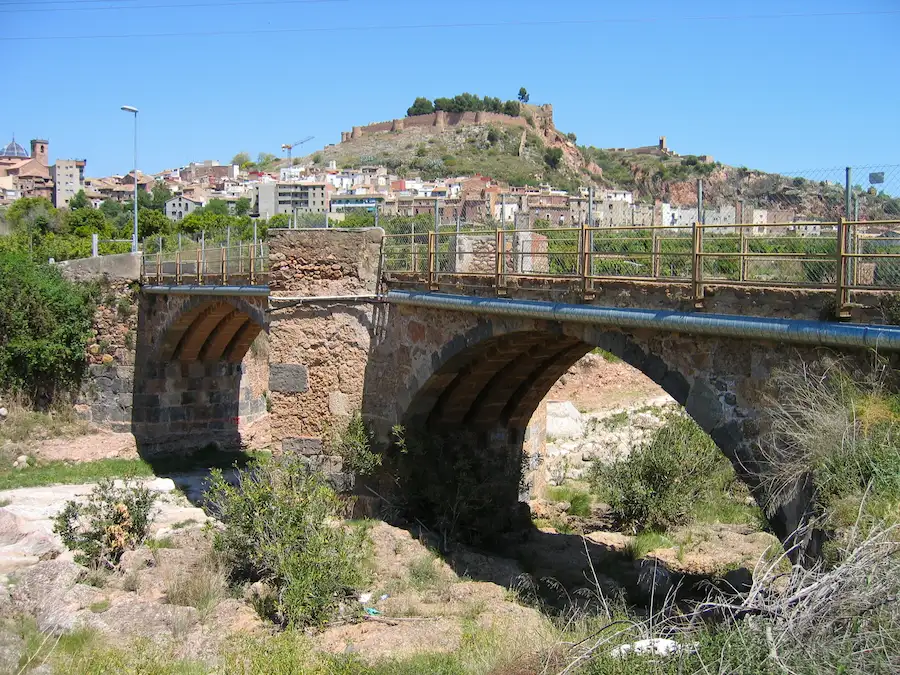
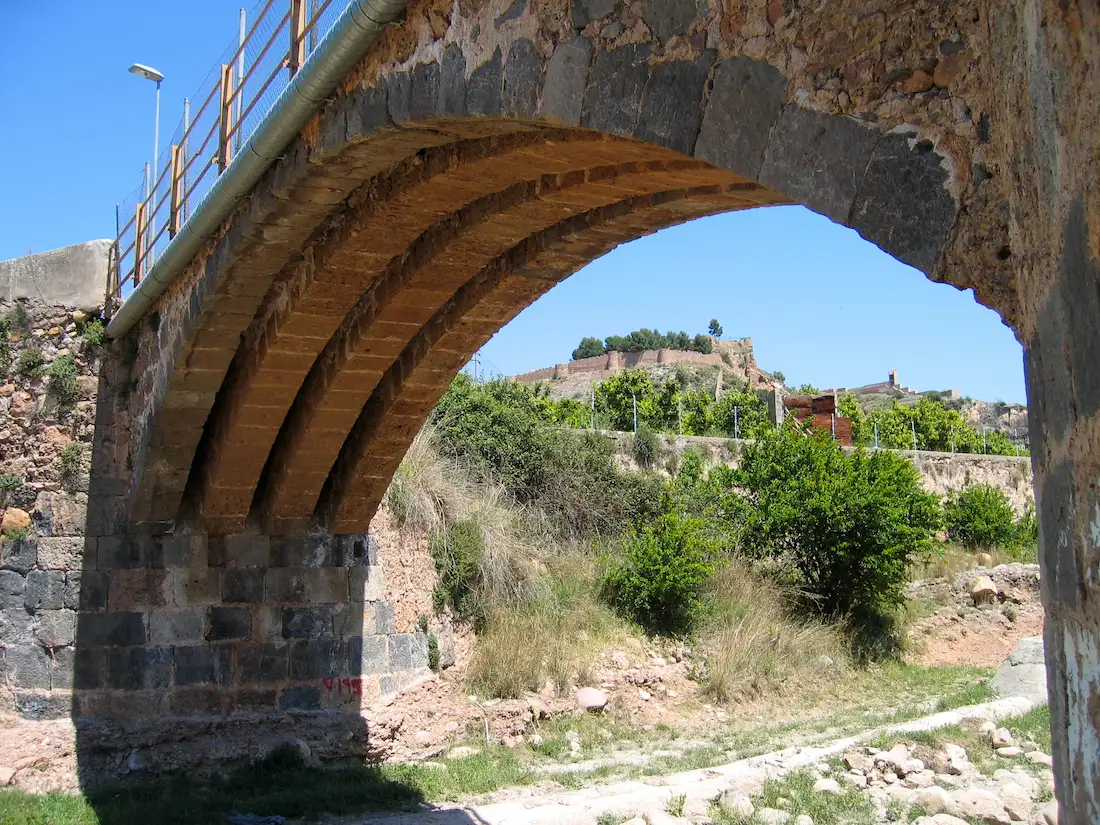
Outside the walled enclosure, crossing the Sonella river, the medieval bridge built in the 16th century was the compulsory crossing on the road to Valencia. Its two pointed ashlar arches, raised on pillars with cutwaters, have withstood centuries of Sonella floods. It still stands and is crossed daily, with modern railings added that do not conceal the solidity of the original structure. From the dry riverbed, the view it offers, with the arch framing the castle hill in the background, is one of the most photogenic in Onda.
In the religious sphere, the Church of the Assumption accumulated artistic works and reforms from the 14th to 16th centuries. Its Gothic tower, one of the most recognisable elements of Onda's urban skyline, was erected in the 14th century. The interior holds frescoes in which, according to local tradition, the painter included the faces of actual residents of the time, and altarpieces attributed to the workshop of Juan de Juanes, the 16th-century Valencian painter who also worked, according to documentation, on the image of the Salvador at the hermitage.
Outside the walls, the Hermitage of the Santísim Salvador gradually consolidated as a place of devotion from the early centuries of the conquest. By around 1241, a small chapel stood on the site where the complex is today. The image of the Salvador, in the late Gothic style, is documented from the early 15th century. The baroque reform of the 18th century, the most visible today, transformed the complex into the sanctuary we know, with its guesthouse, its forecourt and the high altarpiece of 1734.
Ceramics: when a craft becomes an identity
If there is one thread connecting medieval Onda with contemporary Onda, it is made of fired clay and enamel. The ceramic industry of Onda was not born in the 19th century: its roots lie in the artisan tradition of medieval kilns, which in turn drew on Andalusian ceramics and the techniques introduced by the Mudejar craftsmen who remained in the town after the conquest.
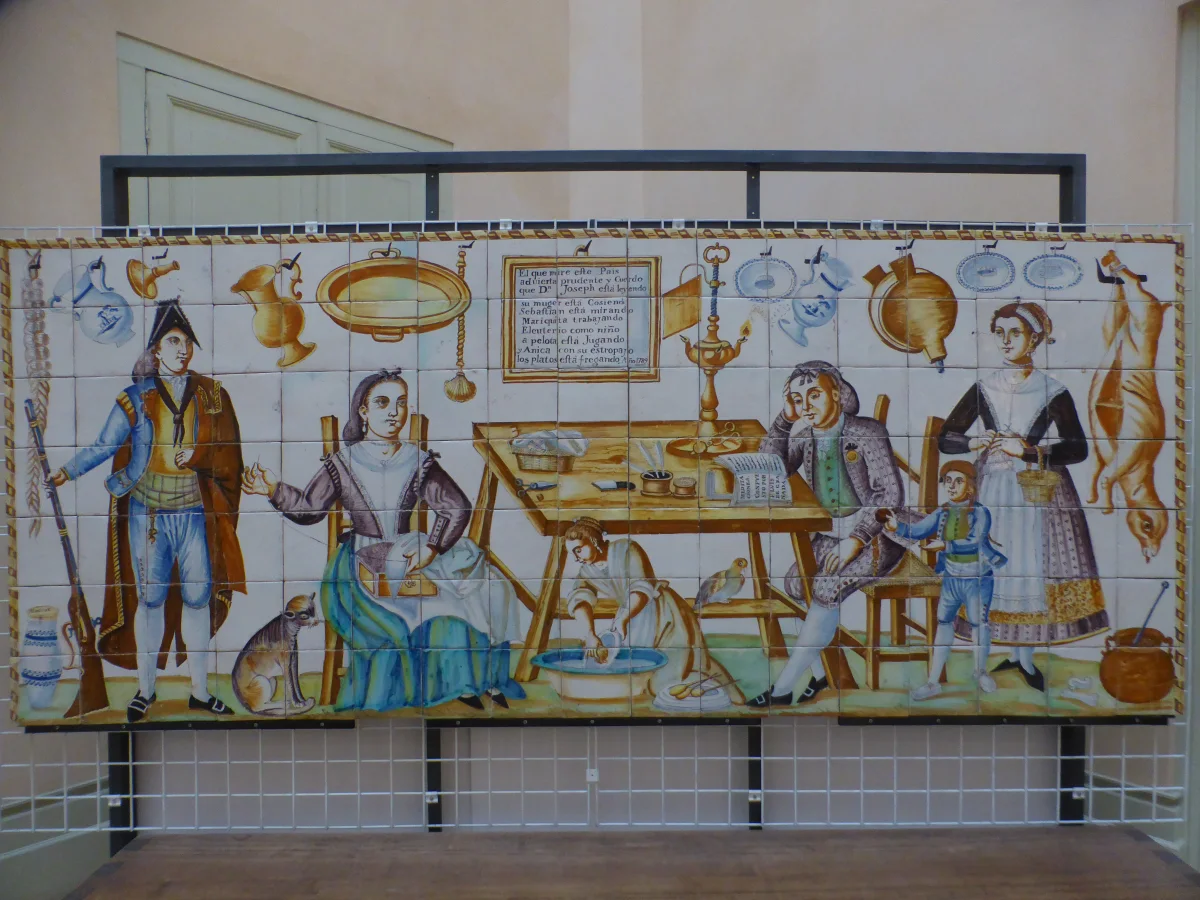
During the 18th century, the production of tiles and decorative ceramics grew steadily. The street chapels with painted tile altarpieces that dot the historic quarter, the sotabalcons (balconies with ceramic panels) of noble houses, the panel of the Ascension on the facade of the Hermitage of the Salvador: all of this reflects that ceramics were in Onda not merely a commercial product, but an aesthetic language woven into urban life.
In the 19th century, industrialisation transformed artisan workshops into factories. Onda, together with Castellón and the neighbouring towns of the Plana, became one of the European centres of production of floor and wall tiles. The opening in 1890 of the steam railway linking Onda with the Grao de Castellón (the port of Castellón) was decisive: for the first time, local production could reach the market on a mass scale through the port. In 1925, the Provincial School of Ceramics was founded, formalising the transmission of technical and artistic knowledge that until then had passed from master to apprentice in the workshops themselves.
That industrial process explains the presence of the Manolo Safont Tile Museum, one of the most comprehensive in Spain in its field, inside a former Franciscan convent in the city centre. Its collection brings together around 30,000 pieces documenting the evolution of the tile from the Middle Ages to contemporary design, with particular attention to the industrial period of the 19th century and to local master ceramicists.
Contemporary Onda: heritage and the future
In 1906, the Vatican declared the Santísim Salvador the patron saint of Onda. Three decades later, the Civil War reached the historic centre: in 1936, bombing and fires damaged churches and convents and destroyed much of the movable heritage accumulated over centuries. The original image of the Salvador, in the late Gothic style, disappeared then; the one that presides over the hermitage today is a post-war recreation made from photographic documentation and historical descriptions.
The Historic-Artistic Complex was declared a Site of Cultural Interest (Bien de Interés Cultural) in 1967, recognising the coherence and value of the old town as a heritage unit. That recognition was not merely symbolic: it guided restoration policy and conditioned urban development in the area around the castle hill, preserving an urban fabric that in many similarly sized cities had disappeared under 20th-century redevelopment.
Today, Onda is a city of around 25,000 inhabitants that combines an active ceramic industry (still thriving in the region) with a living historic quarter, quality gastronomy and a festival calendar whose most moving moment is the Pilgrimage of 5 August: the day when the whole city, for a few hours, climbs the hill to visit the patron saint.
History is not only in the museums. It is in the streets of the Morería quarter, in the arch of the Portal de San Pedro, in the wooden platform that hovers over the remains of the Jewish quarter, in the Mudejar coffered ceiling of the Iglesia de la Sangre, in the blue-tiled dome of the Chapel of Sant Vicent Ferrer. All of it reachable on foot in under an hour from anywhere in the old town.