
A square with memory underfoot
Synagogue Square is one of those places where history is not in a display case or on an information panel, but literally beneath the ground. When urban works were carried out in this part of Onda's historic centre, the excavations revealed archaeological remains from two distinct periods: structures of Islamic origin, from when Onda was an Arab medina, and Gothic elements from the Christian medieval period that was laid over that earlier urban fabric.
The solution adopted to manage the discovery is both practical and effective: a raised wooden platform was installed so that visitors can cross the space without stepping on the remains, while observing the preserved structures at their original ground level. The result is a public space that operates on two planes: the contemporary one, for passage and rest, and the historical one, visible but protected.
The Jewish community of Onda lived in this neighbourhood from the Christian conquest until their expulsion in 1492. Five centuries of concentrated presence within a few streets of the historic centre.
The Jewish quarter: five centuries in the heart of Onda
After the conquest by Jaume I in 1241, the Jews living in Onda settled in their own neighbourhood within the Christian town. Unlike the Moorish quarter (moreria), which was located outside the walls, the Jewish quarter sat inside the walled enclosure, around what is now this square. This reflects a difference in social status within the medieval hierarchy: Jews, though subject to restrictions, were considered subjects of the king and enjoyed a degree of legal protection that Muslims did not have in the same form.
The Jewish community of Onda ceased to exist, like all those of the Crown of Aragon, in 1492, with the Alhambra Decree that ordered the expulsion of those who refused to convert to Christianity. Some converted and remained; others left. The neighbourhood persisted, but without the community that had shaped it for more than two and a half centuries. The name of the square, however, has preserved that memory to this day.
The excavation and the platform
The archaeological remains preserved beneath the platform include structures from two distinct historical periods. The oldest correspond to the Islamic period before the conquest: foundations, floors and fragments of walls that formed part of the urban fabric of the Arab medina of Onda. Over that base, the subsequent Christian occupation left its own Gothic mark: constructive elements, pavements and building remains from the 13th and 14th centuries.
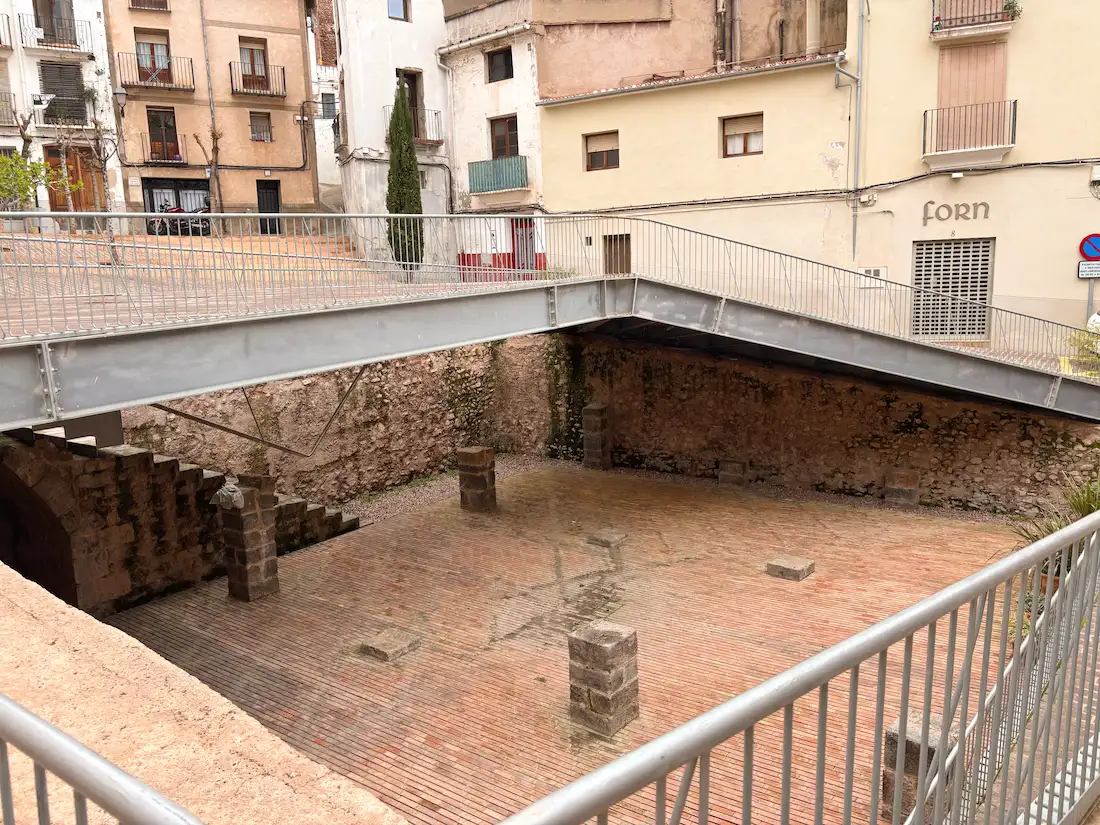
The integration works also recovered the alignment of the old Calle Valencia, which once crossed this area and had been buried by later urban changes. The wooden platform partly follows that original route, helping visitors understand how the neighbourhood was spatially organised at its most active period.
How to visit
The square is in the historic centre of Onda, in the former Jewish quarter, a short walk from the Chapel of Saint Vincent Ferrer and the Church of the Sangre. Access is free at all times: the wooden platform and the archaeological remains are visible from the public space with no booking or opening hours required.
It is a regular stop on the guided tours of the historic centre organised by the Onda Tourist Info office, which provide additional context about the excavation and the history of the Jewish quarter. For dates and prices: C/ Ceramista Peyró s/n, tel. 964 602 855.