
A mosque that changed its skin
In the 13th century, when Jaume I conquered Onda and distributed its territory among Christian settlers, the Muslims who chose to stay were not permitted to remain inside the walled medina. They settled just outside, in their own neighbourhood beyond the walls: the Moorish quarter (moreria). There they built their homes and their mosque, and lived in this way for nearly four centuries, until the expulsion of the Moriscos in 1609.
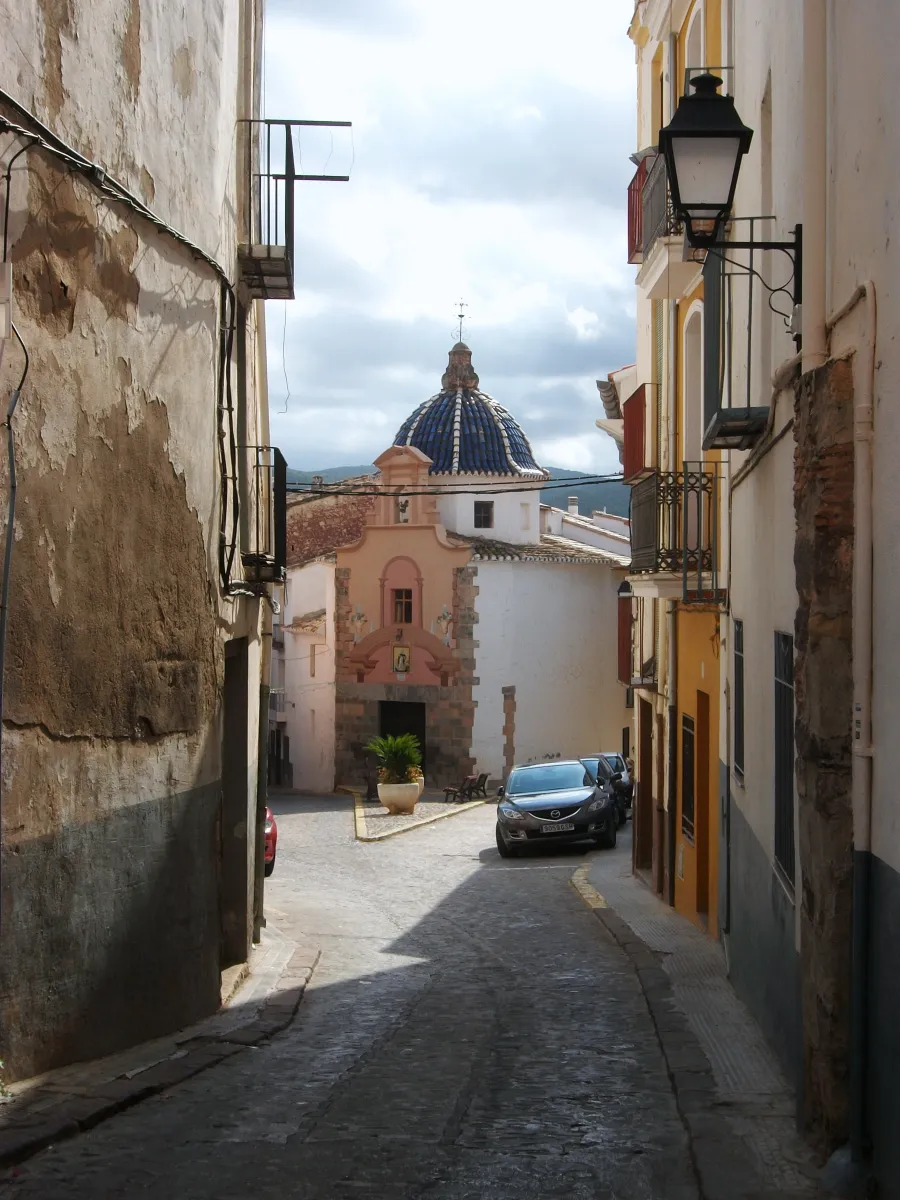
At the centre of that neighbourhood, still recognisable today by its Islamic street plan of dead-end lanes folding back on themselves, stands the Chapel of Saint Vincent Ferrer, built on the exact site of that medieval mosque. The Baroque building visible today was constructed centuries after the Valencian Dominican friar passed through here, but the place has carried his name ever since.
Saint Vincent Ferrer was the most celebrated preacher of his time. When he arrived in Onda he was accompanied by hundreds of flagellants. He preached in the Moorish quarter, on the very spot where the chapel bearing his name now stands.
Saint Vincent in Onda: the preacher of the Apocalypse
Vicent Ferrer (Valencia, 1350 - Vannes, Brittany, 1419) was a Dominican friar who travelled through the Iberian Peninsula and the south of France preaching repentance. He was known as the "Angel of the Apocalypse" because he announced the imminent end of the world in every sermon, and his preachings drew vast crowds. He was canonised in 1455, barely thirty-six years after his death.
Between 1411 and 1413 he undertook a long apostolic campaign through the territories of the Crown of Aragon. It was the era of the Western Schism (two rival popes) and Saint Vincent had been the principal supporter of the Avignon pope, Benedict XIII. His sermons on that tour combined calls for repentance with exhortations to Jews and Muslims to convert to Christianity. According to tradition, he preached in Onda in the Moorish quarter in 1412, before the local Islamic community.
The chapel built to commemorate that episode carries a double symbolic charge: it honours the preaching of one of the most venerated saints of the Valencian Country (he is patron of the entire Valencian Community) and gives physical form, in stone and ceramics, to the conversion of an Islamic space into a Christian one.
The architecture: central-plan chapel and the blue dome
The current building follows the typology of a central-plan chapel characteristic of small 18th-century Valencian Baroque ermitas. The central plan, rather than the usual longitudinal nave, is an architectural gesture: space is organised around a point, not directed towards an altar at the far end. The dome crowning the composition is covered with blue and white glazed tiles, the same material that distinguishes other chapels in Onda's historic centre and which is, in itself, a tribute to the local ceramic tradition.
The facade incorporates a Baroque ceramic altarpiece: a composition of hand-painted tiles depicting the image of the saint. It is one of many devotional ceramic panels that dot the streets and facades of Onda's historic centre, where ceramics are not only industry but also a religious and ornamental language.
The neighbourhood around it
The chapel is inseparable from its urban setting. The Moorish quarter surrounding it retains its medieval Islamic street plan almost unchanged: the streets of San Vicente and de la Morería form an area that folds back on itself, with the logic of Islamic urban design, including indirect access, semi-enclosed spaces and broken sightlines, still legible. At its most active period it was a neighbourhood of more than fifty houses and a few hundred inhabitants.
A short distance away lie three other points that tell the same story of coexistence and separation among Onda's three medieval communities: Synagogue Square (the Jewish quarter), the Church of the Assumption (built, according to tradition, on the site of the main mosque of the medina) and the Portal de Valencia, the gateway into the whole complex. All within a radius of two hundred metres.
How to visit
The chapel stands on Calle San Vicente, in the heart of the Moorish quarter, a couple of minutes on foot from Synagogue Square and the Church of the Assumption. The exterior, including the facade with the ceramic altarpiece and the blue-tile dome, is visible at any time. For the interior, it is worth checking opening hours with the Tourist Info de Onda (C/ Ceramista Peyró s/n, tel. 964 602 855), as times can vary by season.
The visit fits naturally into the historic centre walk: descending from the castle along the walls, you pass the Church of the Assumption, Synagogue Square and the Moorish quarter in a single stroll. The chapel is usually the final stop on that itinerary before turning back towards the town centre.