
Seven centuries in one place
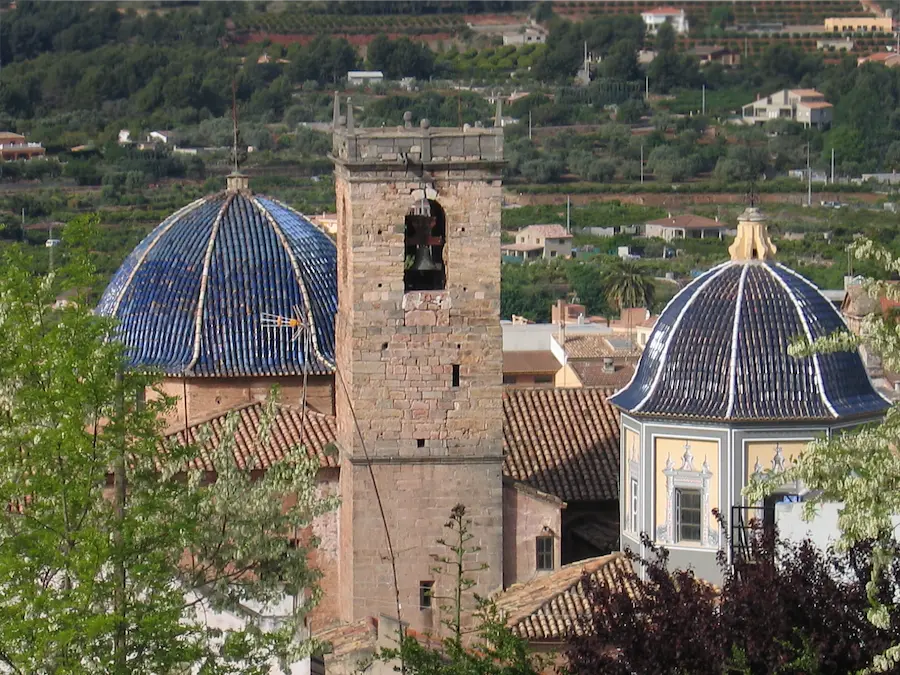
The Church of the Assumption stands on the site where, according to tradition, the main mosque of the Arab medina of Onda once stood. After the Christian conquest of the 13th century, the space was consecrated as a church. In the 14th century a first Gothic building was erected, of which only one element survives: the bell tower, which withstood the devastating fire of 18 December 1467 that razed the rest of the church. Standing alone, that ashlar tower with semicircular arches has been present through every subsequent century of Onda's history.
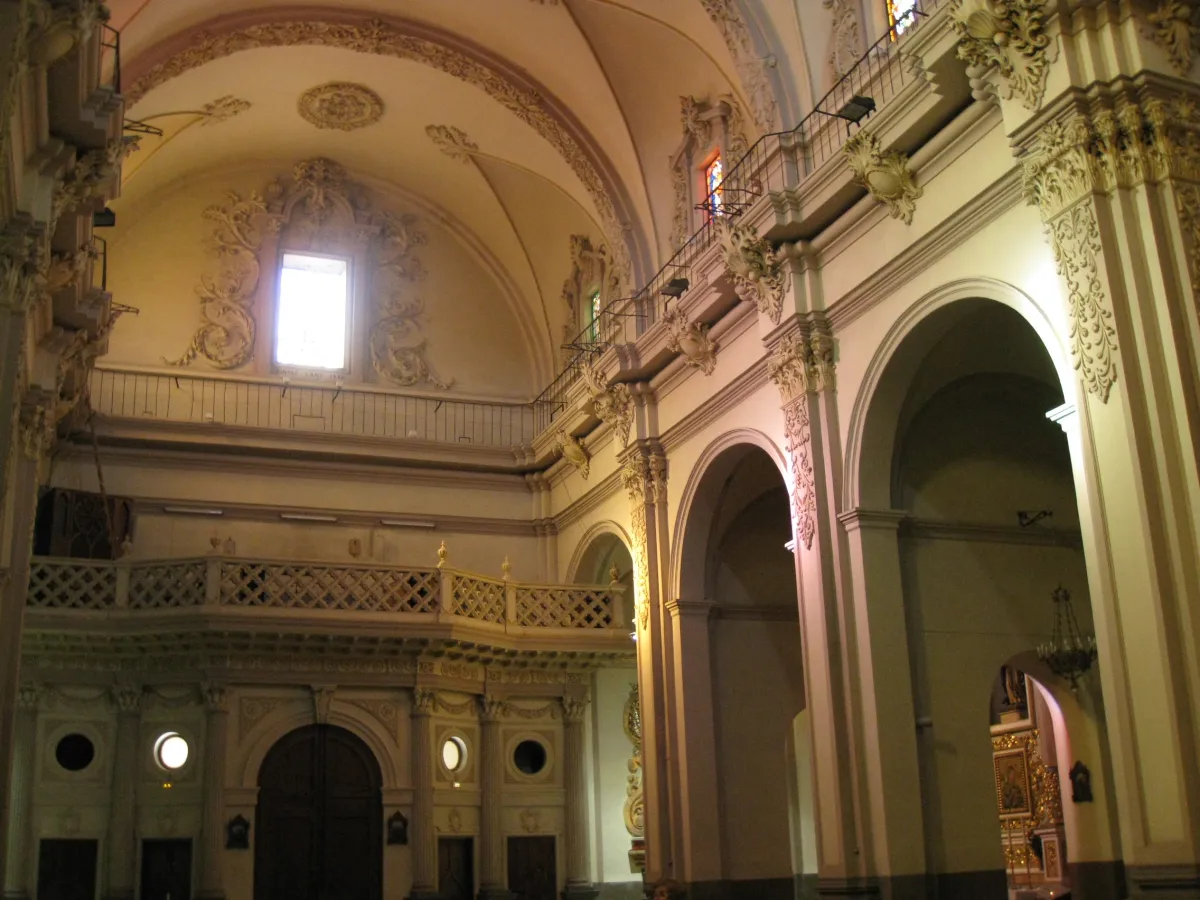
The current church began to be built in 1727. It is Baroque, with a single nave, side chapels, a barrel vault and a dome over the crossing. The Communion Chapel was completed in 1753 and the main doorway in 1854. The interior decoration was finished in the 20th century: the 1936 looting during the Civil War meant everything had to be rebuilt from scratch.
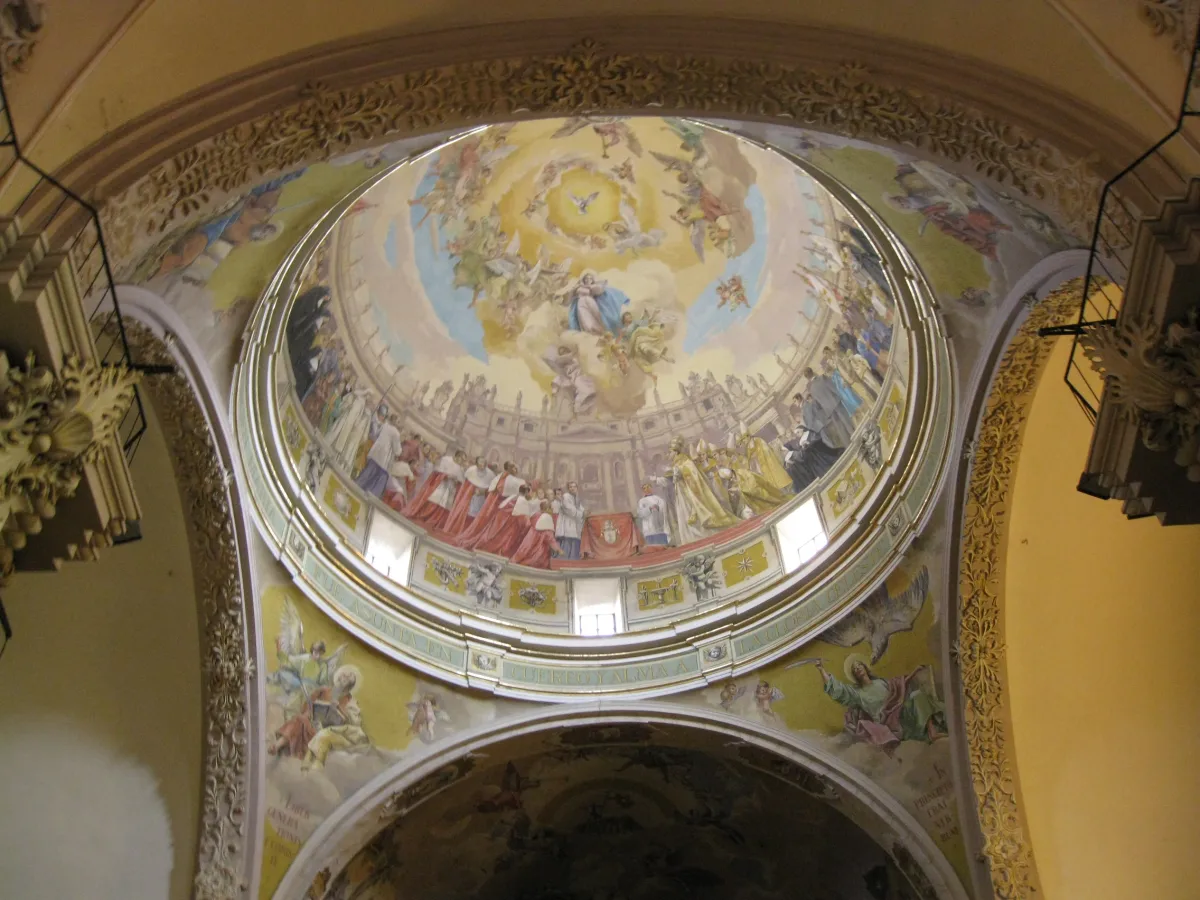
The frescoes on the dome were painted in the 1940s. The models for the religious figures were Onda residents who had helped finance the reconstruction. Their real faces have been there in the vault ever since.
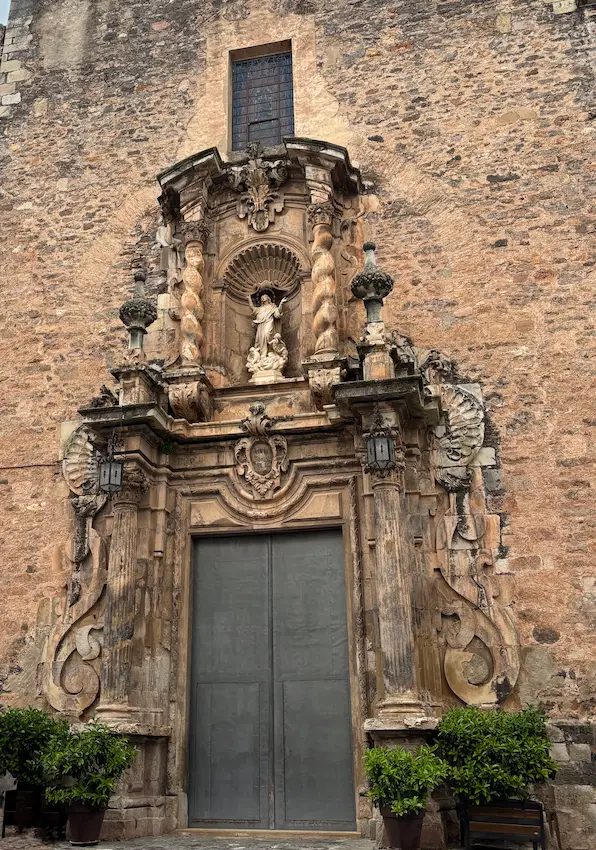
The exterior: three centuries layered
Looking at the church from the Plaza de la Sinagoga is reading the timeline backwards. The main doorway, completed in 1854, is a stone altarpiece with Corinthian columns below and Solomonic columns above: late Baroque that arrived when the rest of Europe had already moved through Neoclassicism. Above it, the plain wall of the 18th-century Baroque nave. And rising higher still, the 14th-century Gothic bell tower, with its four semicircular arches and pilasters, solid and unperturbed.
In the interior courtyard, beside the base of the tower, there is a detail that very few visitors seek out: one of the ashlars bears a carved Roman inscription, traditionally dated to the 1st century AD, reused as building material in the Middle Ages. The stone travelled from Roman times to the medieval period without anyone erasing it.
Attached to the east, the Communion Chapel has a Greek-cross plan and its own dome. Completed in 1753, it is the space where the church's connection with local ceramic tradition is most visible: the 18th-century azulejo (decorative ceramic tile) skirting tiles are original and survived the 1936 looting.
The interior: frescoes with familiar faces
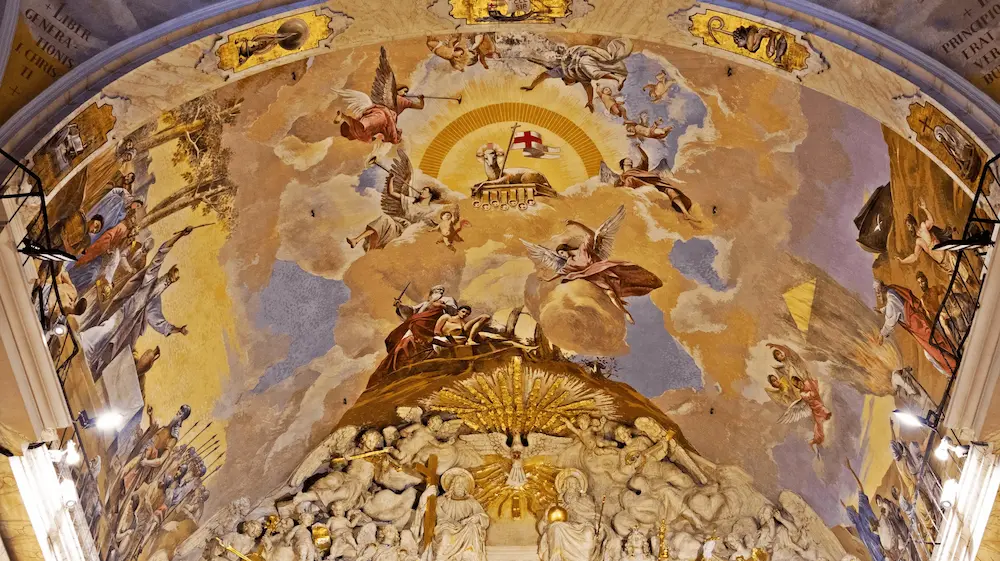
The interior decoration was completely rebuilt after the Civil War. The fresco cycle on the main dome depicts the Coronation of the Virgin with the Evangelists, and includes the faces of Onda residents who helped fund the reconstruction, alongside the parish priest, nuns and friars.
Several artists worked here in the postwar period: the paintings visible today are attributed to Catalan painter Juan Masague, who used local Onda people as models, with decorative contributions from artists including Pascual Santos Albella.
The high altarpiece, the baptismal font and the altar in the Communion Chapel are the work of sculptor Folia de Sant Jordi, a direct pupil of Auguste Rodin. He came to Onda drawn by the fame of its ceramics and did not live to see his work finished: he died before the church was complete.
The azulejo inside the church
The relationship between the Church of the Assumption and Onda's ceramics is not merely decorative: it is structural. The 18th-century azulejo (decorative ceramic tile) skirting tiles in the Communion Chapel are a document in their own right, bearing witness to Onda's ceramic output in its golden age. In the same chapel there is an element that many visitors do not immediately recognise: a mid-20th-century ceramic mural by Manolo Safont (Onda, 1928-2005), the ceramicist who would give his name decades later to the Museu del Taulell (Tile Museum). The mural, titled "The Assumption of Our Lady", has a semicircular composition and is made up of hundreds of hand-painted tiles.
The sacristy functions as a picture gallery and holds works ranging from the 15th to the 19th century, including a 16th-century altarpiece attributed to the Master of Cabanes (father of Juan de Juanes) and another attributed to Juan de Juanes himself (1558), one of the key figures of the Valencian Renaissance.
Practical tips
The church is at the Plaza de la Sinagoga, in the heart of Onda's historic quarter. Admission is free. It usually opens several days a week during the morning and some afternoons, but tourist visiting hours outside Mass times should be confirmed at the Tourist Info, as they vary with the season and religious calendar.
To see the Roman inscription you need to enter the side courtyard by the tower, which is usually accessible. The dome fresco is best appreciated from the centre of the nave in good natural light, which enters through the side windows in the morning. The Communion Chapel, with the Safont mural, is to the right of the high altar.