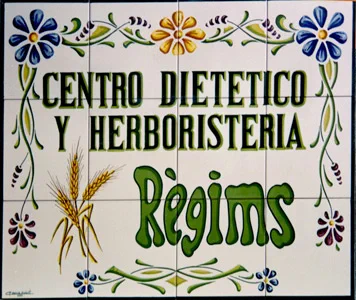
The workshop is on Avenida del País Valencià, with its door open to the street. There is no divide between the counter and the workbench: if you walk by, you can see the pieces in progress. With luck, Francisco painting. You don't even need to go in.
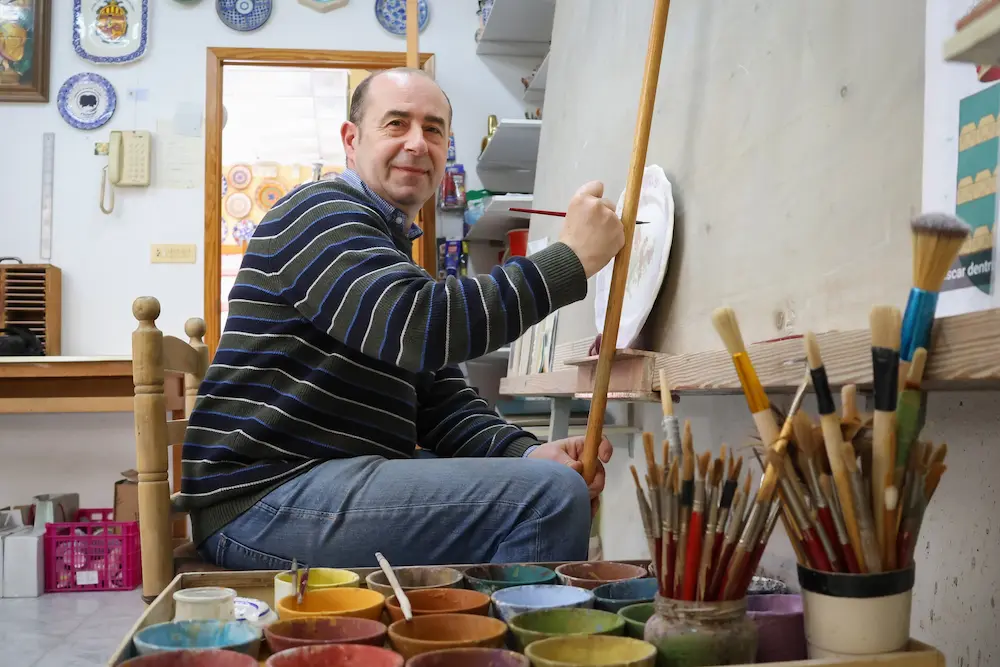
He has been at it for forty-five years. He came to ceramics with nobody in his family having done it before: he started from zero, as an apprentice. In 1994 he opened the workshop with Vicent Aguilella, a ceramicist whose work is in collections in Spain, Cuba, Holland and Russia. When Aguilella died in 2006, Francisco carried on alone. The workshop you see today is the one they built together.
Before the brush, the stylus
There is something you don't notice at first glance when you look at one of his pieces: before the brush touches anything, Francisco traces the design onto the raw glaze with a stylus, line by line. That step alone can take a whole day. The paint comes afterwards, also by hand, applied directly onto the unfired glaze.
When the piece goes into the kiln (a thousand degrees, twelve hours), the glaze vitrifies and the colours are fused in for good. No transfers, no digital printing: what you see on the piece is pigment fired into the ceramic.
"While factories do everything in ceramics through printing, I do it by hand."
Francisco García Gisbert, Castellón Plaza (2022)Onda has seventy-one factories making ceramic floor and wall tiles. And two workshops that still do this by hand.
The cemetery angel and San Elías
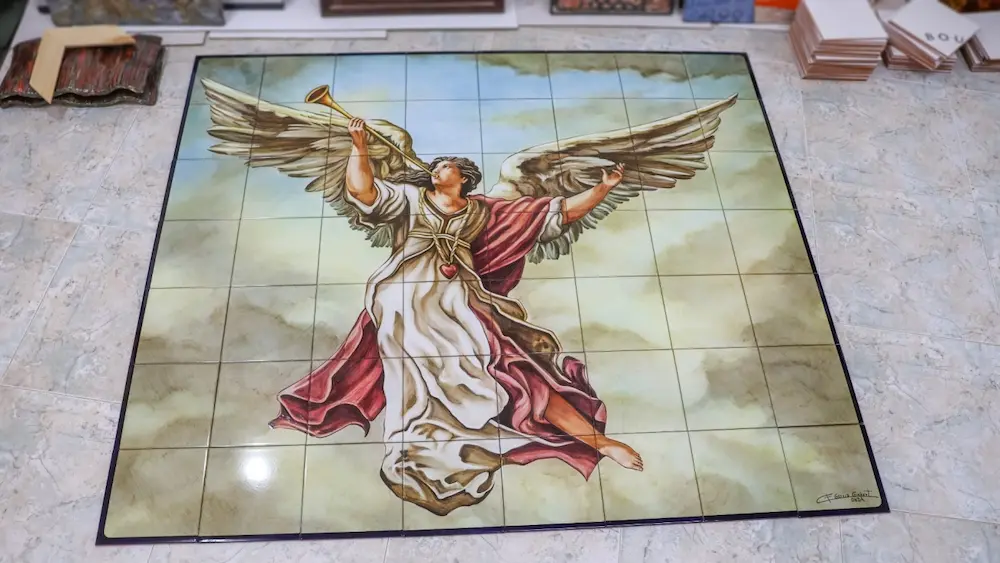
There is work by Francisco out on the street, although you have probably walked past it without knowing. In the municipal cemetery there is an angel with a trumpet that he painted in 1990. Thirty-five years outdoors, and the colours are still there.
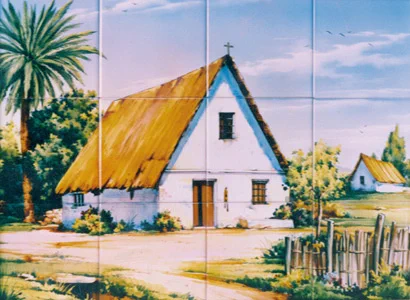
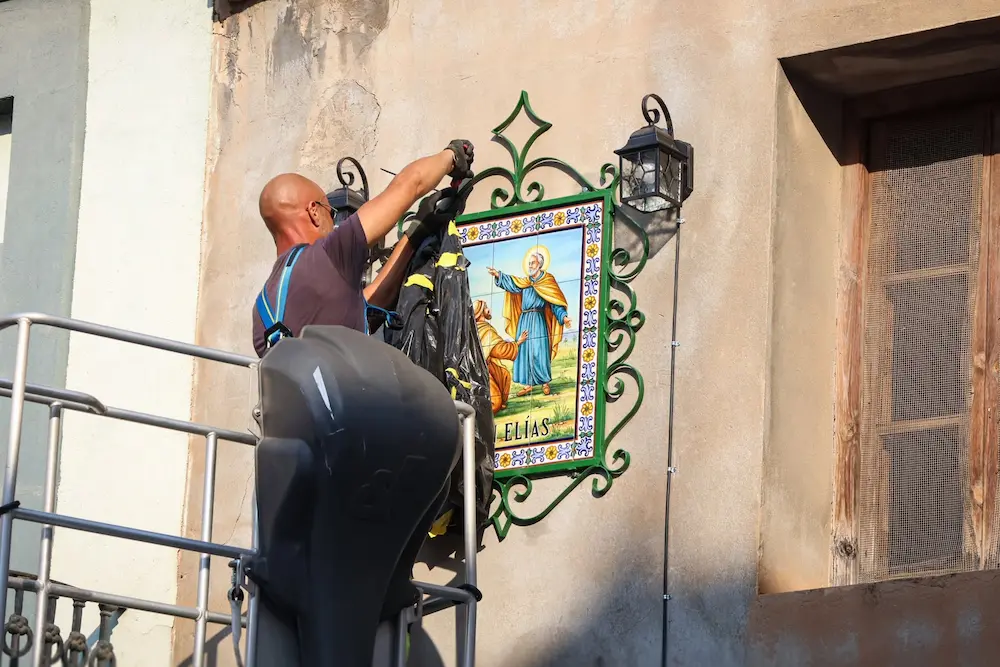
In 2024, residents of San Elías street asked the Town Council to restore the image of San Elías that watched over a damaged niche. The commission went to Francisco. He made a faithful reproduction of the original.
His pieces also travelled to the international exhibition of the European Route of Ceramics: three plates and a coffee set in cobalt blue, with the caragolets motif. The snail is the element that marks traditional Onda ceramics, and you can see it at the Manolo Safont Tile Museum.
Commissions, not a catalogue
There is no catalogue. If you want to order something, you walk in, describe what you have in mind, and Francisco tells you whether it can be done. Murals, signs, tiles with a particular motif for your home or business: every piece is made to measure, in whatever size you need.
For firing he uses the kilns of the industrial factories in the area, because his own would burn twelve kilowatts for twelve hours, a cost no small workshop can bear since energy prices rose. Onda's craft and its ceramics industry remain connected in ways that are not always visible from outside.
He can work this way because he owns the premises. Without that, the margins would not add up. Selling online makes no sense either: packaging and shipping make it unviable to send fragile ceramics at a distance. All of this works here, in person, in the shop.