
The El Carmen Museum closed in December 2022. In June 2025, Onda Town Council and the Carmelite community signed a 30-year municipal transfer agreement. The renovation project, named MICO (Museu Immersiu de Ciències d'Onda), plans to reopen with immersive technology, augmented reality and virtual reality.
A 15th-century convent housing ten thousand specimens
The first time you walk into El Carmen Convent in Onda, you start doing mental calculations. The building was erected by Carmelite friars around 1437, on the site of an earlier 14th-century hermitage. For four centuries it was monastic life. Then the 19th century brought desamortizacion (the secularisation of church properties) and abandonment, until restoration began in 1879. And in 1965, the same Carmelites still living in the convent decided to fill its halls with something else entirely: more than ten thousand pieces of natural history.
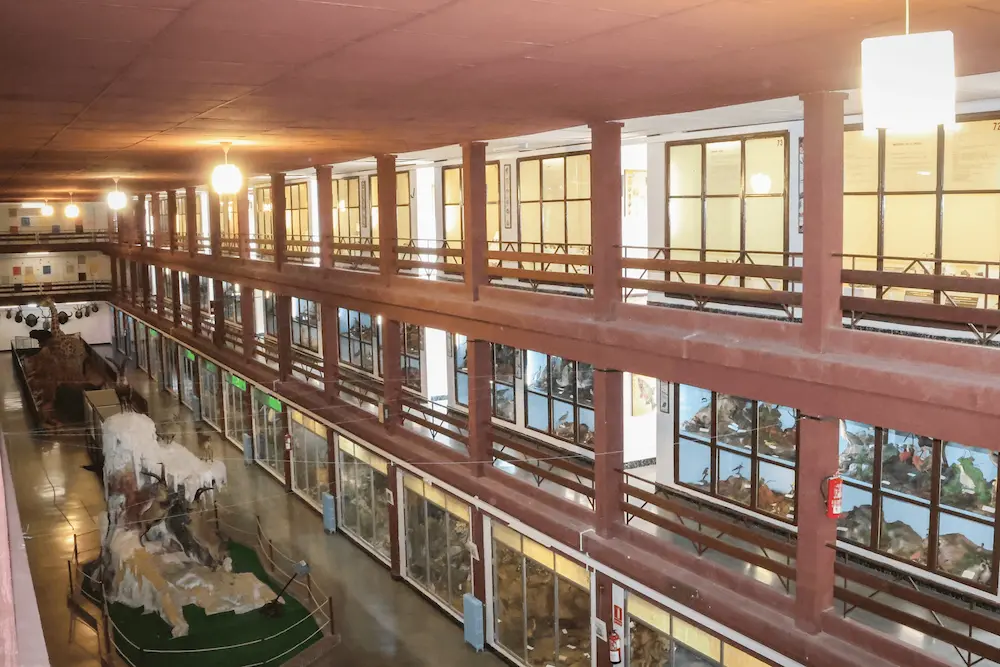
The result is the Natural Sciences Museum El Carmen, one of the longest-established natural history museums in the province of Castellon and, without question, one of the most surprising for a city of twenty-five thousand inhabitants. The collection spans three floors and covers fauna from all five continents, entomology, botany, mineralogy, palaeontology and malacology, arranged in one hundred dioramas recreating natural habitats from around the world.
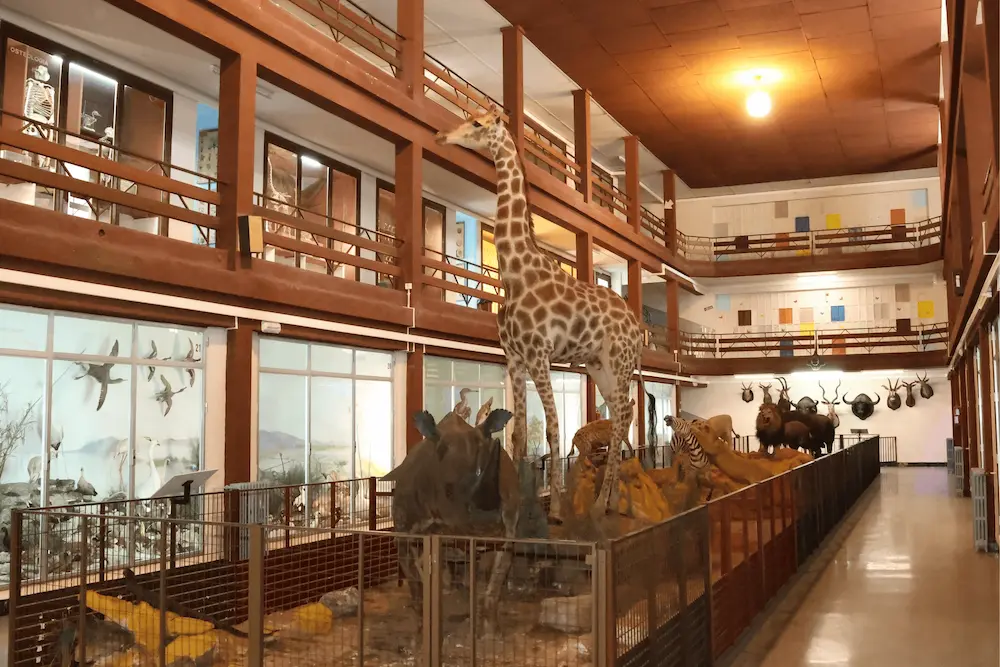
More than ten thousand specimens from five continents, arranged in one hundred dioramas by Carmelite friars since 1965. There are cities ten times larger than Onda with nothing remotely comparable.
Three floors: what's inside
The ground floor opens with the most immediate content: a large collection of taxidermied animals displayed in dioramas recreating natural habitats. The specimens come from all five continents and are arranged by geographic origin. Mammals, birds, fish, reptiles, crustaceans and amphibians share scenes designed to convey the original context of each species.
The first floor ventures into less expected territory. There is an entomology section with hundreds of insect species, a bird egg collection and display cases of malacology (shells and molluscs from around the world). There is also a section on human biology and comparative anatomy. And a collection of animals with genetic malformations that tends to stop visitors in their tracks more than anything else: among the specimens are a two-headed lamb, a pig foetus with cyclopia and a one-eared rabbit. This is not sensationalism; it is science applied to the rarest of anomalies.
The second floor is devoted to geology, chemistry and evolution. The mineral and fossil collection, with thousands of specimens, traces the development of life on the planet. It is perhaps the densest floor conceptually and the one that rewards those who take their time.
The convent is also a sanctuary
El Carmen Convent is not only a museum container. It is also the Sanctuary of Our Lady of Hope, the patron saint of Onda, which gives the visit a double dimension. The sanctuary church, neo-Gothic in style with integrated Gothic remains, is open to visitors and forms part of the complex. The two aspects coexist: natural sciences museum and active religious life under the same roof, on the outskirts of the town, surrounded by the countryside near the Sierra de Espaadan.
MICO: what is coming
In 2025, Onda Town Council and the Carmelite community signed a free transfer agreement for the museum spanning several decades. Under this agreement, the museum is entering a profound transformation: immersive technology, augmented and virtual reality, interactive panels and a comprehensive accessibility overhaul. The project is known as MICO and draws inspiration from major international natural history museums such as the Smithsonian Institution in Washington.
The transformation does not erase the existing museum; it amplifies its capacity to communicate what it already holds. Ten thousand real specimens, assembled over decades by the Carmelites, are the permanent collection. What changes is how the story is told.
When it reopens as MICO
The museum is on the Carretera de Tales, s/n, about 2 kilometres from the centre of Onda. It is not within the historic quarter: on foot from the centre is around 25 minutes, by car there is parking by the building. The location will not change with the renovation.
A full visit of all three floors, when the museum was open, took between one and a half and two hours at a leisurely pace. With the new immersive format of MICO, the visit is expected to be longer. El Carmen Convent, home of the museum since 1965, is also part of the renovation project.
On the grounds adjacent to the convent, open to the public since April 2026, is the MICO Gaming Zone: over 8,000 m² of sports courts, a children's area and a restored pelota court, free and open to all.
It is on the same road that connects to several points in the Sierra de Espaadan, so the visit can be combined with a hiking route through the natural park.