
The Franciscans and the road through the orchards
In 1455, the Franciscan order founded the Convent of Santa Catalina on the outskirts of Onda, to the south of the town, in a fertile orchard area watered by the Sonella river descending from the sierra. To connect the town with the convent and ease the movement of people and goods (oil, wine, vegetables) without relying on the natural ford, a dressed-stone bridge was built. The exact date is undocumented, but architectural evidence places the work in the 16th century, possibly over an earlier structure.
The bridge accumulated different names over the centuries. Sonella Bridge is the usual one, after the river it crosses. Locals also called it the "Bridge of Saint Francis" after the friars of the convent it served, and it occasionally appears as the "Dry River Bridge", because the Sonella runs dry for much of the year. One crossing with several names that was, for centuries, the only way to cross the river without getting your feet wet.
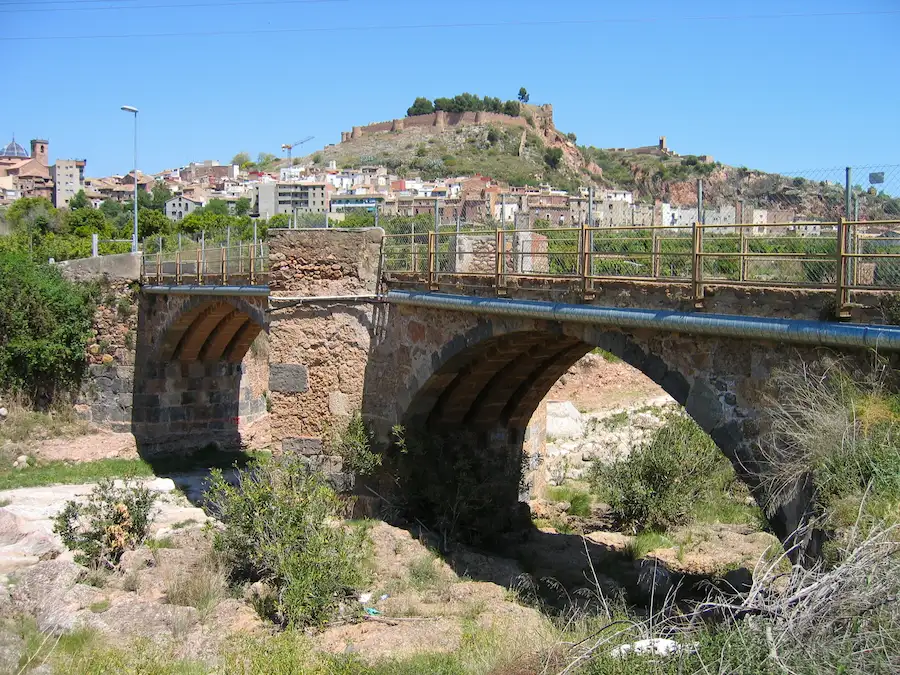
Dressed stone, arches and a central cutwater
The bridge measures 28.5 metres in length and 3.4 metres in width, with two dressed-stone arches separated by a hexagonal central pier that acts as a cutwater against the Sonella's flash floods. The materials combine worked ashlar on the structural elements with rubble masonry and mortar joints on the upper sections, a common approach in 16th-century civic construction across the comarca. It is a functional piece of work, without ornamental ambitions, built to last and to serve.
The convent that vanished
The Convent of Santa Catalina that the bridge served stood for nearly four centuries. In 1836, during the Carlist Wars, a contingent of Portuguese volunteers serving the liberal army burned the building down. The Franciscans abandoned it. Only the hermitage and the chapel of the Calvary survived, and both can still be visited a short walk from the bridge along the Santa Catalina path.
The bridge, however, held on. It remained the regular crossing for the orchards for over a century, until Onda's growth and road traffic made it necessary to build a modern bridge alongside it. The work was carried out around 2006-2007 and, as the new crossing was inaugurated, the medieval bridge was restored at the same time: pipes and concrete applications that had accumulated over the original stone were removed, the parapets were rebuilt with river pebbles and lime mortar, and a stairway down to the riverbed was added. The project received funding from the Diputació Provincial de Castelló.
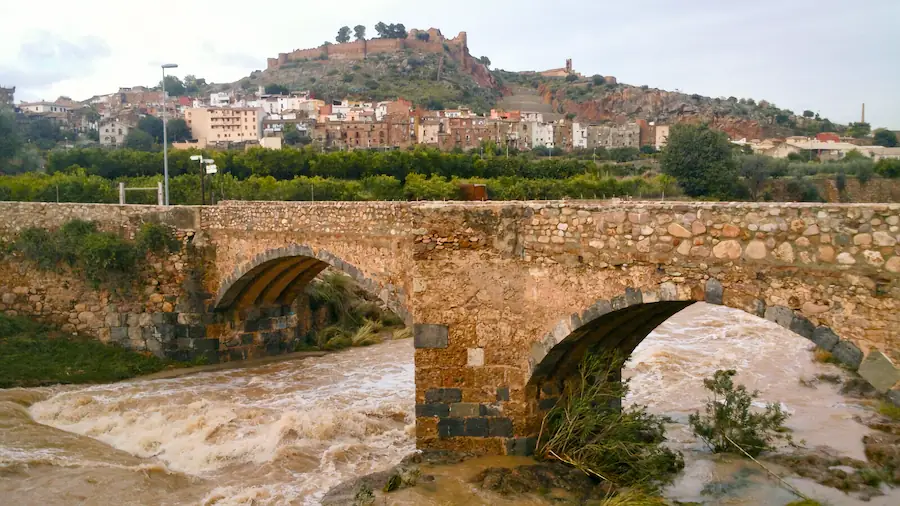
"The convent lasted four centuries.
The bridge has seen five."
Getting there and what to see
The bridge is about a 20-minute walk from the centre of Onda, following the avenue heading south until you reach the Sonella riverbed. It forms part of the waymarked trail SL-CV 106 (Onda - Coves Gelades - Calvari - Onda), a low-difficulty route that starts at the Molí de la Reixa and passes alongside the bridge before climbing toward the Calvary and the remains of the Convent of Santa Catalina. It is also a waypoint on the Jaume I Routes of the Valencian Community.
From the area around the bridge, looking north, one of Onda's most distinctive views opens up: the Castle of the 300 Towers on the hilltop, with the Espadà mountain range behind it. A different perspective from the one you get from the old town, and one that makes the walk worthwhile even if the bridge itself is not a monument that impresses by sheer size.