
The Franciscan convent that did not survive the Carlist Wars
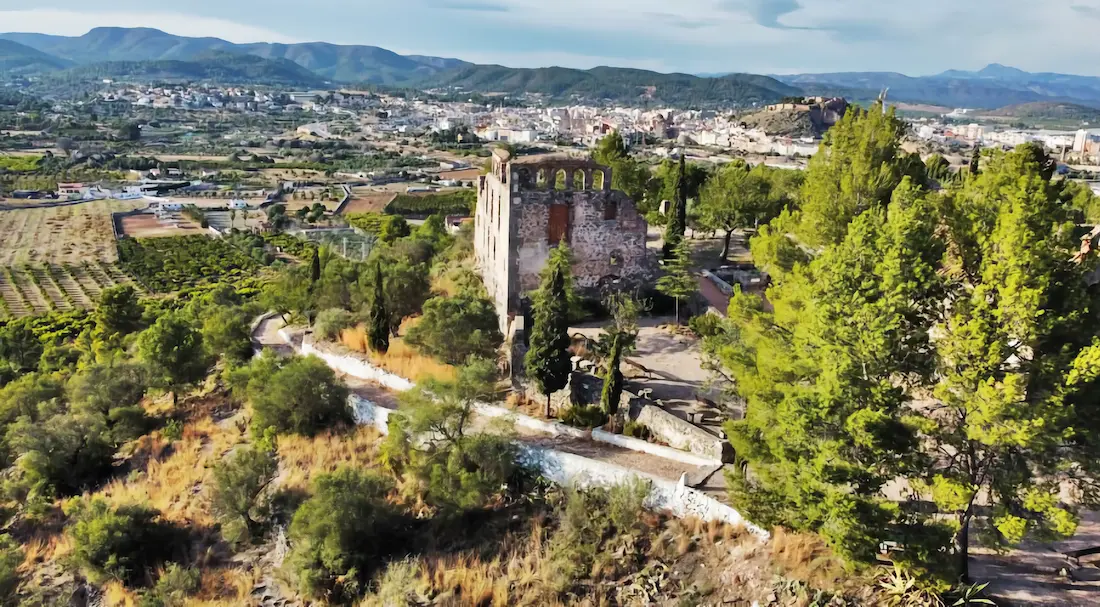
In 1455 the Franciscan order established the Convent of Santa Catalina on the southern outskirts of Onda, on a fertile plot of farmland watered by the Sonella river. The complex grew over time: church, cloister, gardens, friars' quarters and a Way of the Cross path climbing the hillside. To connect the town with the convent without relying on a river ford, the Sonella Bridge was built during the 16th century and still stands today.
In 1836, during the Carlist Wars, a contingent of Portuguese volunteers in the service of the liberal army burned the building. The Franciscans abandoned it. A convent that had functioned for nearly four centuries was reduced to bare walls in a matter of hours.
The fire spared the hermitage and the Calvary chapel. The ruins of the main building, with its arches and the remains of three storeys, have stood for nearly two centuries without anyone demolishing them completely.
The Calvary: the oldest in the province
The Calvary of Onda was not always in this location. It was originally installed at the foot of the castle, in the heart of the old town. In 1851, fifteen years after the fire, the local authorities decided to move it to the grounds of the ruined convent, integrating it into the hillside landscape and giving it a scale the old town could never have accommodated.
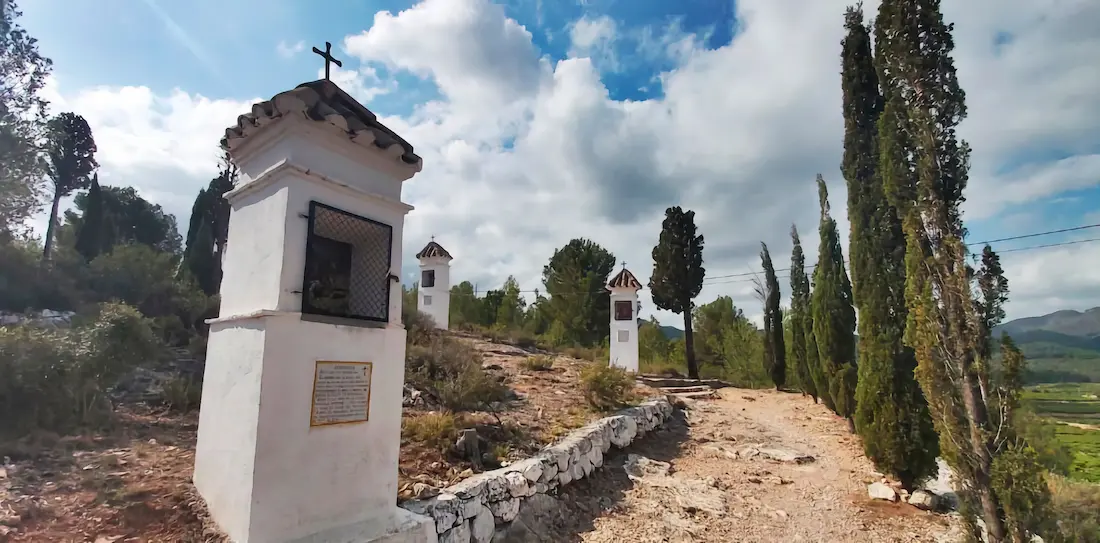
The path climbs in a zigzag from the cemetery to the Calvary chapel, with the ceramic altarpieces of the fourteen Stations of the Cross placed along the route. Those altarpieces, made between 1940 and 1960, are the finest example of devotional ceramics that Onda produced in the 20th century: hand-painted tiles depicting scenes of the Passion, in the style the local factories had mastered over generations.
The designation of this Calvary as the oldest in the province of Castellón refers to the devotional tradition of the site, not to the current altarpieces, which date from the 20th century. The practice of the Way of the Cross here predates the 1851 relocation.
The Hermitage of Santa Catalina
The hermitage is the best-preserved building in the complex. It has free access and serves as the landmark of the path. Its architecture is austere: rubble masonry walls, small openings, a single nave. There is no decorative flourish. What it has is context: to be inside is to be surrounded by the ruins of the convent, with the Calvary hillside visible through the door and the Sonella river below.
Next to the hermitage stand the remains of the main convent building: a three-storey structure whose arches still hold. Elsewhere this ruin would be fenced off and signposted as a monument; here it simply exists, without much fuss.
The SL-CV 106 trail and how to get there
The site is incorporated into the waymarked route SL-CV 106 (Onda – Coves Gelades – Calvary – Onda), a circular walk of low difficulty starting at the Molí de la Reixa, skirting the Sonella riverbed past the medieval bridge, ascending to the Calvary and returning to the starting point. The section from the cemetery to the Calvary chapel is the most frequently walked stretch.
From Onda town centre, the site is about 25 minutes on foot heading south along the main avenue to the Partida Sant Francesc. There is roadside parking at the entrance. The path has benches, water points and interpretation panels installed by the council. Access is free. For tourist information call 964 602 855 (Turisme d'Onda).
What to see in the complex
The natural route starts at the base of the Calvary by the municipal cemetery and climbs to the chapel. The fourteen Stations are marked with ceramic tile altarpieces: some well preserved, others showing the wear of seventy years outdoors. At the top, the Calvary chapel closes the route.
From there you can descend to the hermitage and the convent ruins a few metres away. The entire complex, including the walk to Sonella Bridge, can be visited in under two hours at a relaxed pace. This is a short excursion with remarkable historical density: a 16th-century bridge, a 15th-century convent, a 19th-century relocated Calvary and 20th-century ceramic tiles, all within the same kilometre of path.