
Casa de Dalt does not have open visiting hours. To access, book an appointment via [email protected] or check casadedalt.es. Guided tours and temporary exhibitions are also available.
Two collections under one roof
In the Calle Santa Isabel of Onda's historic quarter stands a restored old house that holds two collections which, together, tell a story neither could tell alone. The first is the Onda Collection: the most important known set of 19th-century popular Valencian ceramics, focused on earthenware made in Onda and complemented by pieces from Ribesalbes and Manises. The second is the Manolo Safont Room, opened in April 2026, with thirty works by the Onda ceramist spanning from 1950 to 1995.
The space is home to the Gorriz-Beltrán Foundation, which has been collecting pieces with scholarly rigour for over fifteen years: not to accumulate, but to document a ceramic tradition that in Onda has both industrial and artistic roots. The result is an intimate-scale museum, unspectacular in size but very dense in content.
In the late 18th century, Onda and Ribesalbes established earthenware factories modelled on the one in Alcora. In the 19th, each developed its own style. Onda specialised in tiles and high-volume earthenware; the Onda Collection gathers what remains of that chapter.
The Onda Collection: earthenware nobody had assembled before
19th-century Onda ceramics were for decades undervalued by major museums, precisely because they were popular: mass production, aimed at a broad public, with fewer artistic pretensions than Alcora earthenware or Italian majolica. That made them vulnerable to oblivion and hard to assemble. The Onda Collection reversed that reasoning: popularity was exactly what made them interesting.
The collection includes plates, tiles, and singular pieces that document the distinctive styles Onda and Ribesalbes developed from the 1820s onward. Alongside the local production, pieces from Manises allow the Onda ceramics to be placed within the broader map of 19th-century popular Valencian ceramics.
The Manolo Safont Room
Manolo Safont (Onda, 1928-2005) is the most important ceramist the city has produced. The Tile Museum has carried his name for decades; now Casa de Dalt adds a space dedicated entirely to his pictorial work, installed in the original attic room on the building's third floor.
The thirty works are arranged chronologically, turning the visit into a journey through Safont's evolution as an artist: from his first abstract works of 1959, through the socially and politically charged pieces made between 1968 and 1975, to the mature work where his mastery of ceramic material reaches its highest point.
It is a small, concentrated space. There are no distractions. The pieces speak of an artist who used his city's industrial tradition as a starting point to create something entirely different.
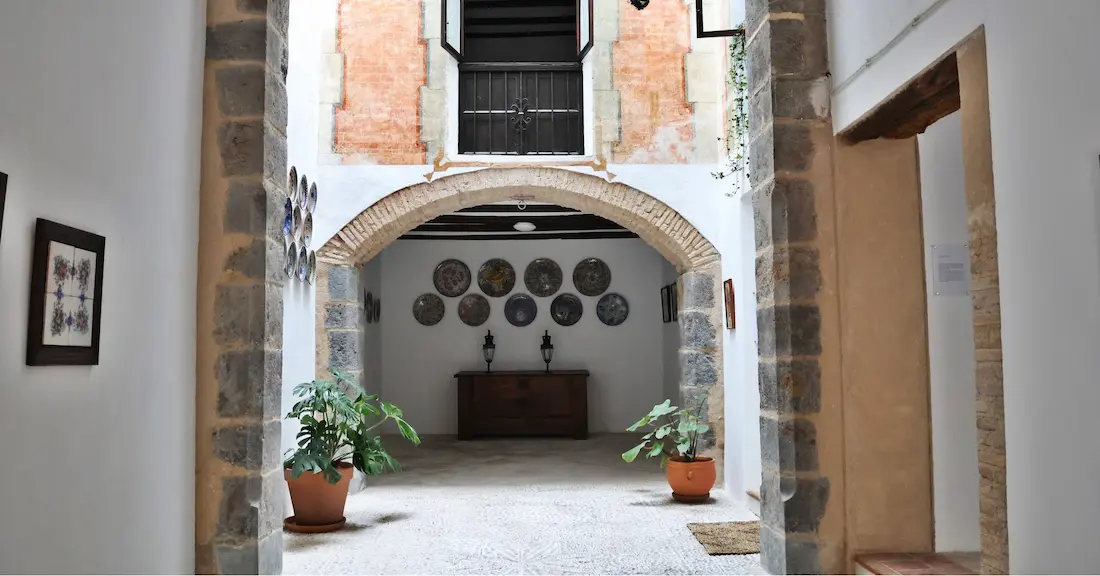
The building
The restoration of the house respected the original structure, including the attic room on the third floor: a space that in traditional Valencian houses served as storage and which here has become the container for the Safont Room. The decision to install the works in the attic is not accidental: the space has a low ceiling, contained light, and a scale that forces you to stand close to the pieces.
The building is on Calle Santa Isabel, in the heart of the historic quarter, a few minutes from the Tile Museum and the Church of the Blood.