
The waterfall that weeps for itself
Salto de la Novia is the name everyone uses for the Cascada del Brazal, a roughly 60-metre waterfall in the Río Palancia gorge at Navajas. It is one of the most visited natural sites in the Alto Palancia valley, with managed access, an interpretation centre, short waymarked trails and the well-known legend of the two young lovers.
The place combines several things at once: the main waterfall, swimming in the river at the base of the falls, several short forest trails, prehistoric rock shelters at the Bora de las Peñas, and an interpretation centre at the entrance. This is a full-day plan, not a half-hour stop.
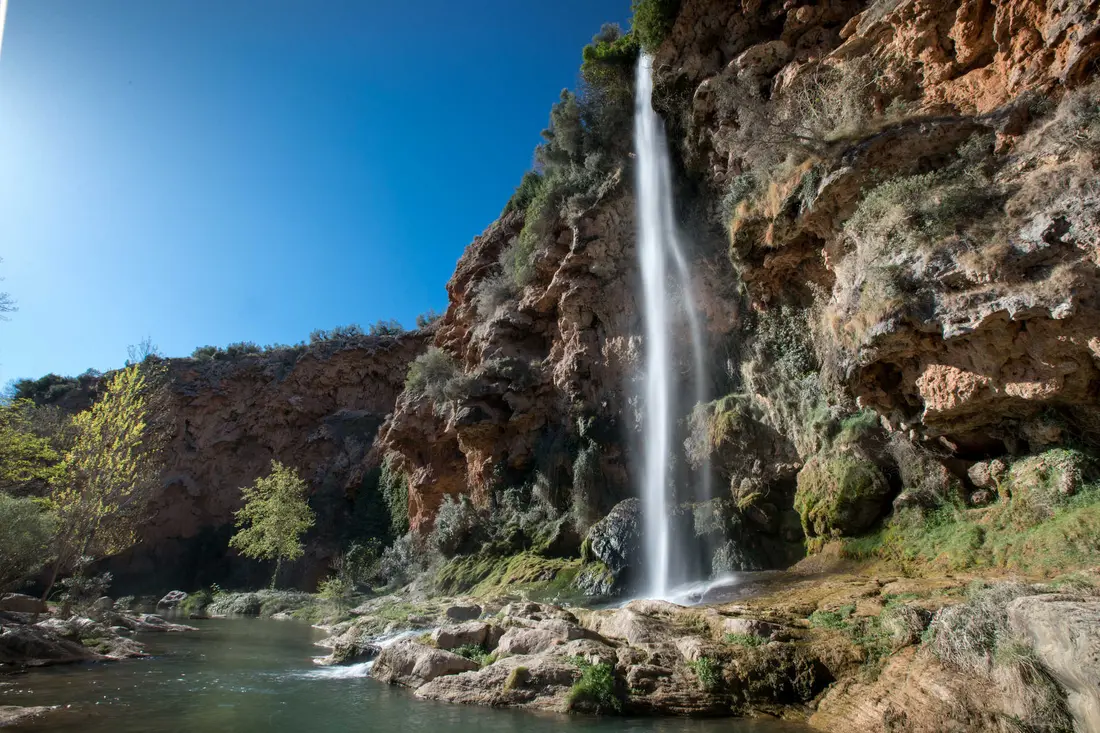
Legend has it that the waterfall's waters are the tears of two young lovers who drowned in the river trying to cross it to prove their love.
The waterfall and its surroundings
The water that forms Salto de la Novia comes from the Manantial de la Esperanza spring, which drains the Jérica-Alcublas aquifer. It falls onto a platform of calcareous tufa formed 2.5 million years ago by the precipitation of calcium carbonate in contact with fresh water. The canyon carved by the falls, known as La Bora de las Peñas, reaches about 50 metres at its highest point.
The popular name comes from a local legend. In Navajas there was once a custom of brides leaping from one riverbank to the other in front of their neighbours as a test of love. On one occasion the Palancia was running high, the bride fell into the water and the groom jumped in to save her. Both drowned. Since then the Cascada del Brazal has carried the bride's name, and people say the water are her tears. Some scholars connect the story to an etching by Francisco de Goya held at the Hispanic Society of New York.
At the foot of the falls there is an open area with picnic tables and access to the Río Palancia for swimming. The water is cold even in summer. You can stand under the waterfall when the flow allows it. Dogs are welcome but must stay on a lead and cannot swim.

What else to see beyond the waterfall
The Mirador del Paraíso (Paradise Viewpoint) offers the best perspective of Salto de la Novia: reached by stairs cut into the canyon wall (slippery ground, take care) it gives a panoramic view of the main waterfall and the river from above. On the way to the viewpoint you pass the Cascada del Tío Juan, the smaller sibling of Salto de la Novia, which carries more or less water depending on the season.
The site has several short waymarked trails, all accessible from the entrance:
- Last Kiss Trail (Senda del Último Beso): from the Fuente de Mosén Miguel spring to the base of the waterfall.
- Old Brides' Trail (Senda Antigua de las Novias): runs parallel to the river with small spots for swimming.
- Solitude Refuge Trail (Senda del Refugio de la Soledad): an out-and-back walk to a small natural shelter, rarely busy.
- Riverside Forest Trails (Sendas del Bosque de Ribera): follows the left bank of the Palancia to La Barchilla, a medieval 14th-century weir.
In the rock shelters of La Bora de las Peñas there are remains of prehistoric archaeological heritage: a Copper Age necropolis, Bronze Age rock shelters and the Cueva del Ermitaño cave, inhabited until the 18th century.
Navajas and the 400-year-old elm
The village deserves a stroll before or after visiting the waterfall. Navajas was one of the favourite summer retreats of Valencians throughout the 19th and early 20th century, and a number of grand 18th-century manor houses with gardens survive. In the Plaza del Olmo (Elm Square) stands a tree planted in 1636: nearly 400 years old, 13 metres tall, and prominent in the town's coat of arms and anthem. The route to Salto de la Novia begins next to the elm.
The Calle Bajada de las Fuentes, which descends from the square towards the nature site, passes several springs in different shapes along the way. Here you will also find the Interpretation Centre, where tickets are sold and information on the local flora, fauna and archaeology is displayed.
How to visit Salto de la Novia from Onda
From Onda, take the CV-20 or the N-225 to join the A-23 (Autovía Mudéjar) towards Teruel. After Segorbe, take the exit for Navajas. The total distance is about 50 km and 46 minutes of driving. The train is also an option: the C5 Cercanías line Valencia–Caudiel stops at Navajas, from where the waterfall is a 10-minute walk.
Parking is at the Plaza del Matadero, next to the Interpretation Centre. On summer weekends the area fills up quickly. On weekdays outside July, August and September the site is almost deserted and entry is free.